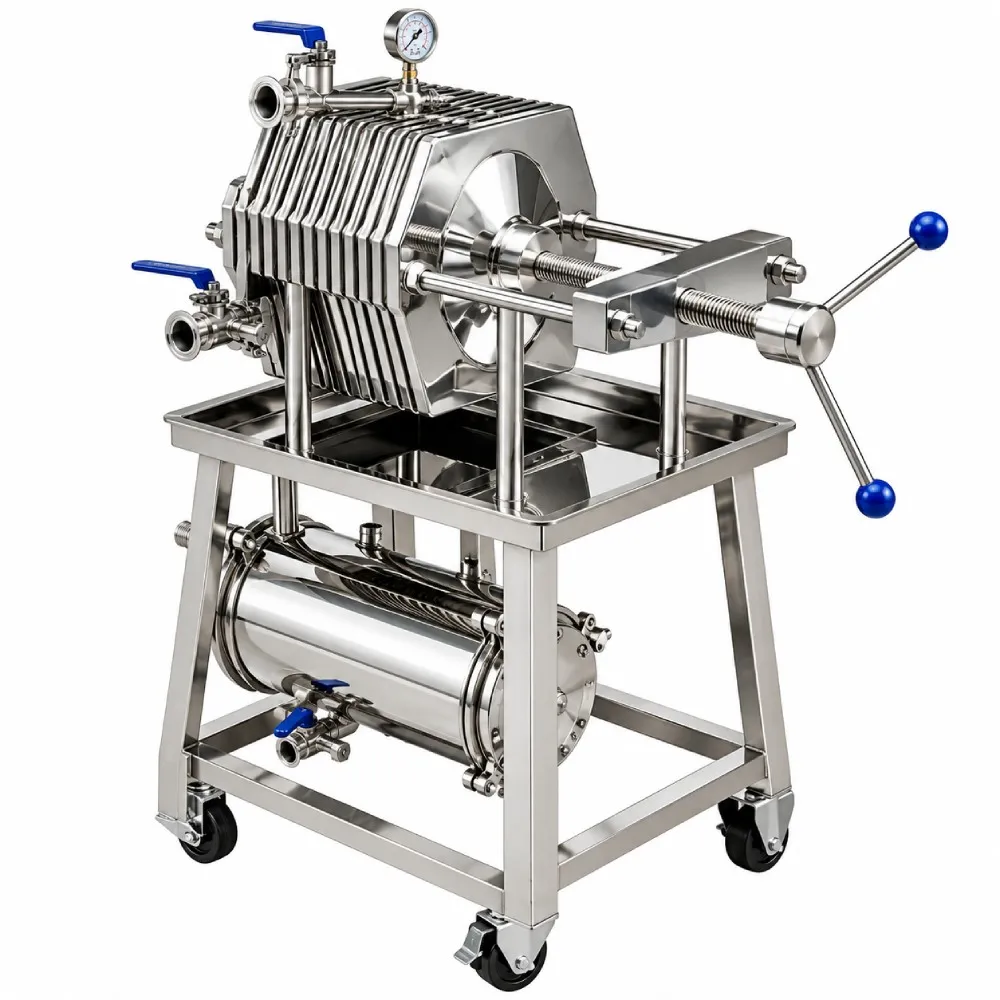
Fully Automatic Plate And Frame Filter
Oystar Fully Automatic Plate and Frame Filter is designed for compatible industrial liquid filtration and solid-liquid separation applications. Contact Oystar Dairy Fittings to enquire about specifications, automation options, filtration capacity, and pricing.
Material Compliance & Dimensional Specifications
Standard dimensions and manufacturing tolerances adhering strictly to ASTM and sanitary standards:
The Fully Automatic Plate and Frame Filter from Oystar Dairy Fittings is designed for industrial filtration processes that require efficient separation of suspended particles and unwanted solids from liquids. It is suitable for applications where consistent filtration, reduced manual intervention, and improved process efficiency are important.
A plate and frame filtration system works by passing liquid through filter media supported by plates and frames. Suspended particles are retained while the filtered liquid passes through the media. In a fully automatic configuration, suitable automated controls and operating mechanisms can help manage selected filtration stages and reduce routine manual work.
The exact automation functions depend on the selected model and configuration. Depending on the process requirements, the equipment may be specified for filtration capacity, filter media compatibility, liquid characteristics, operating pressure, temperature, and cleaning requirements.
Oystar is a brand of Oystar Dairy Fittings, serving industrial buyers seeking filtration equipment for dairy processing, food and beverage production, pharmaceutical applications, and other compatible industrial processes. Buyers should confirm the required filtration grade, construction material, automation features, and process parameters before purchasing.
3. Applications of Fully Automatic Plate and Frame Filter
The Oystar Fully Automatic Plate and Frame Filter can be considered for compatible liquid filtration processes, including:
Dairy processing: Filtration of suitable dairy process liquids and ingredients.
Food and beverage production: Removal of suspended particles from compatible liquids.
Industrial liquid filtration: Separation of solids from process fluids.
Ingredient processing: Filtration of selected liquid ingredients before subsequent processing stages.
Pharmaceutical processing: Applications requiring suitable materials, hygienic design, and validated process compatibility.
Chemical processing: Filtration of compatible liquids according to material and operating limits.
Plant process filtration: Integration into production lines where controlled filtration is required.
The final application must be assessed according to the liquid composition, viscosity, particle size, hygiene requirements, and filter media specifications.
4. Industries Where the Product Is Used
The Fully Automatic Plate and Frame Filter may be suitable for the following industries, subject to process compatibility:
- Dairy and milk processing plants
- Food processing industries
- Beverage manufacturing units
- Pharmaceutical manufacturing facilities
- Biotechnology and ingredient processing
- Chemical manufacturing industries
- Industrial liquid processing plants
- Edible oil and related processing facilities
- Specialty ingredient manufacturers
- General manufacturing facilities requiring solid-liquid separation
For food, dairy, and pharmaceutical applications, confirm the required hygienic design, material certifications, cleaning procedure, and regulatory compliance before ordering.
5. Benefits of a Fully Automatic Plate and Frame Filter
Reduced manual intervention: Automation can reduce routine operator involvement in supported filtration stages.
Efficient solid-liquid separation: Filter media retain suspended particles according to their filtration characteristics.
Process consistency: Appropriate operating controls can help maintain repeatable filtration procedures.
Production integration: The equipment can be specified for suitable industrial process lines.
Application flexibility: Filter media and configuration can be selected according to the liquid and filtration objective.
Operational convenience: Automated functions may simplify selected operating steps.
Process-focused design: Equipment selection can be matched to capacity, liquid properties, and plant requirements.
Industrial filtration support: Useful for operations that need controlled separation of suspended solids