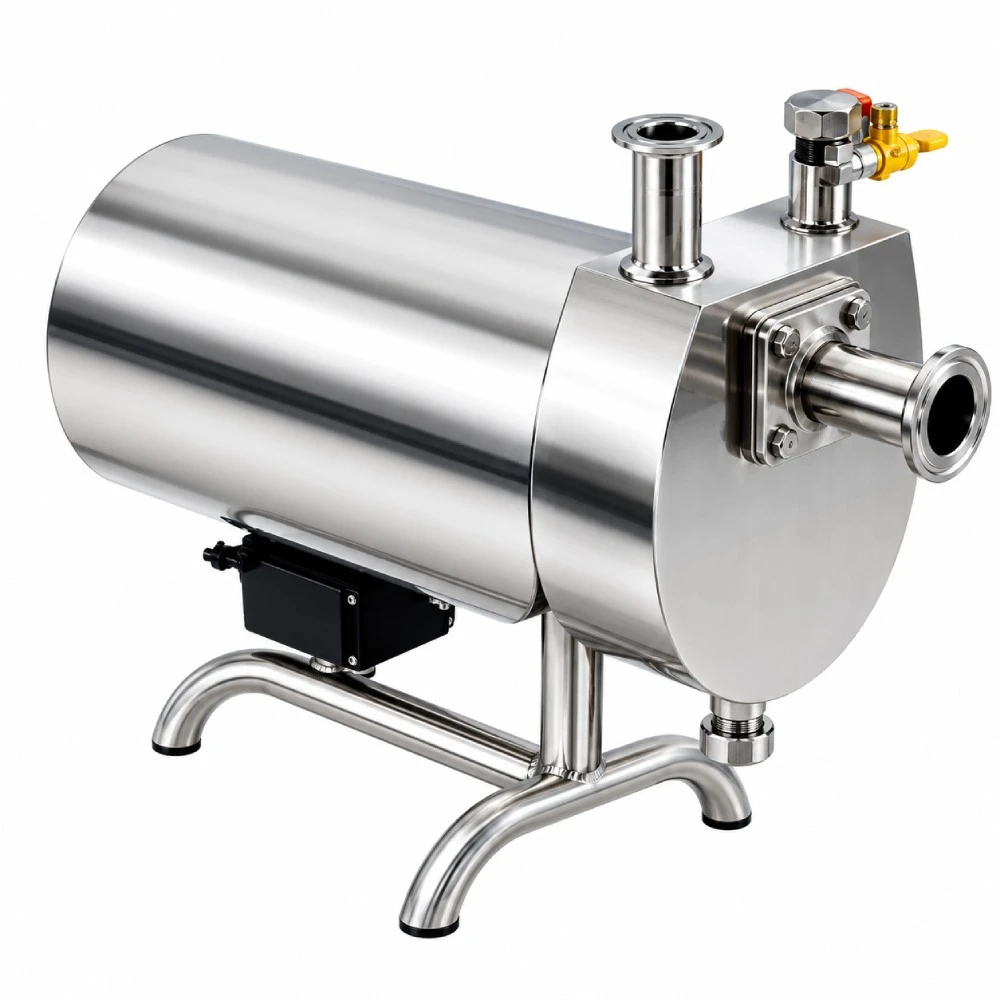
Sanitary Pump
Oystar sanitary pumps from Oystar Dairy Fittings support hygienic liquid transfer in dairy, food, beverage and compatible processing industries. Contact us to confirm pump specifications, materials, flow capacity, availability and pricing.
Material Compliance & Dimensional Specifications
Standard dimensions and manufacturing tolerances adhering strictly to ASTM and sanitary standards:
Oystar Dairy Fittings offers sanitary pump solutions designed for hygienic liquid transfer in dairy, food processing, beverage production, pharmaceutical manufacturing and other industries that require clean and controlled fluid handling. The Oystar sanitary pump range is intended for applications where product hygiene, reliable operation, ease of cleaning and process efficiency are important.
A sanitary pump transfers liquids between tanks, pipelines, processing equipment and filling systems while supporting hygienic production practices. Depending on the selected model and configuration, sanitary pumps can be suitable for milk, cream, liquid food products, beverages, syrups and other compatible process fluids.
Sanitary pumps are commonly designed with product-contact surfaces and connections appropriate for hygienic processing environments. The pump type, body material, seal arrangement, flow capacity, operating pressure and temperature limits should be selected according to the fluid properties and process requirements.
As a sanitary pump supplier, Oystar Dairy Fittings helps industrial buyers identify suitable equipment for their production systems. Customers should confirm the pump construction, connection type, motor specifications, cleaning requirements and compatibility with the intended liquid before placing an order.
3. Applications of Sanitary Pumps
Sanitary pumps support liquid movement across hygienic production and processing systems. Common applications include:
Milk transfer: Moving raw milk and processed milk between tanks, processing lines and storage systems.
Cream and dairy products: Transferring cream, liquid dairy ingredients and other compatible products.
Food processing: Handling liquid food ingredients, sauces, syrups and other suitable fluids.
Beverage production: Transferring juices, flavoured drinks and beverage ingredients.
Pharmaceutical processing: Supporting compatible liquid transfer processes when the pump meets the required hygiene and regulatory specifications.
Filling and packaging lines: Feeding suitable liquids to filling machines and packaging equipment.
Tank-to-tank transfer: Moving liquids between storage, mixing, blending and processing tanks.
Process pipelines: Integrating into hygienic pipelines and production equipment.
The correct pump depends on viscosity, solids content, flow requirements, temperature, chemical compatibility and cleaning procedures.
4. Industries Where Sanitary Pumps Are Used
Sanitary pumps are used in industries where hygienic liquid handling and product quality are essential.
- Dairy processing plants
- Milk collection and chilling centres
- Cheese, butter and cream manufacturing units
- Ice cream production facilities
- Food processing industries
- Juice and beverage manufacturing plants
- Bottled water and liquid food production, where compatible
- Pharmaceutical manufacturing
- Biotechnology and selected process industries
- Personal care and cosmetics manufacturing
- Industrial kitchens and commercial food production
- Hygienic ingredient processing facilities
The suitability of a particular Oystar sanitary pump should be verified against the industry\\\'s hygiene standards and process requirements.
5. Benefits of Sanitary Pumps
Hygienic liquid handling: Designed for applications where cleanliness and product-contact material selection are important.
Efficient fluid transfer: Helps move compatible liquids between processing stages, storage tanks and production equipment.
Process integration: Can be selected for suitable hygienic pipeline, tank and filling-system installations.
Cleaning and maintenance considerations: The correct pump design can support practical cleaning and maintenance routines. CIP or SIP compatibility must be confirmed for the selected model.
Material compatibility: Appropriate body and seal materials can be selected according to the fluid, temperature and cleaning chemicals.
Production support: Helps maintain a consistent liquid-transfer process when correctly sized for the application.
Versatile applications: Different pump configurations can serve different flow, pressure and liquid-handling requirements.
Operational reliability: Proper selection, installation, inspection and maintenance can help support dependable performance.