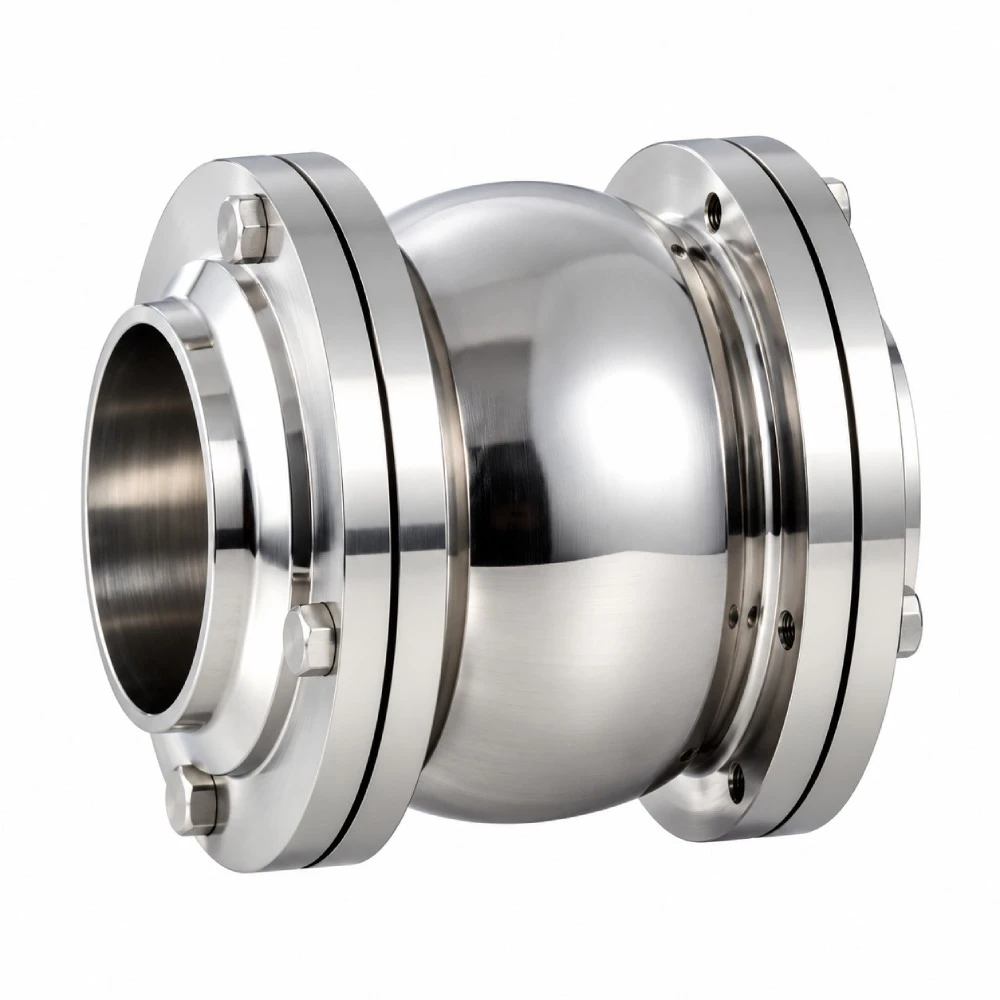
Sanitary Welded Ball Check Valve
Oystar Sanitary Welded Ball Check Valve helps restrict reverse flow in compatible hygienic pipelines. Suitable for selected dairy, food, beverage and process applications. Contact Oystar Dairy Fittings to confirm materials, sizes, specifications, availability and pricing.
Material Compliance & Dimensional Specifications
Standard dimensions and manufacturing tolerances adhering strictly to ASTM and sanitary standards:
Oystar Dairy Fittings offers the Sanitary Welded Ball Check Valve under the Oystar brand for hygienic fluid-handling systems used in dairy, food processing, beverage production, pharmaceutical manufacturing and other process industries. This valve is designed to help prevent reverse flow in compatible pipeline systems while supporting reliable process operation.
A ball check valve uses a movable ball to control the direction of fluid flow. When fluid flows in the intended direction, the ball moves away from the sealing position. If reverse flow occurs, the ball moves toward the seat to help restrict backflow. The exact operating characteristics depend on the valves design and installation conditions.
The welded connection provides a permanent pipeline joint when the valve is installed using a compatible welding procedure. This makes it suitable for selected process lines where a fixed connection is preferred over a removable clamp or threaded connection.
Oystar Sanitary Welded Ball Check Valves can be considered for applications requiring hygienic pipeline design, dependable flow control and reduced risk of reverse flow. Buyers should confirm the valves construction material, seal compatibility, pressure rating, temperature range, dimensions and cleaning requirements before ordering.
3. Applications of Sanitary Welded Ball Check Valves
Sanitary Welded Ball Check Valves are used in compatible fluid-processing systems where reverse flow must be restricted.
- Dairy product transfer pipelines
- Milk processing and handling systems
- Food ingredient transfer lines
- Beverage processing pipelines
- Liquid processing and storage systems
- Hygienic process equipment
- Selected pharmaceutical and biotechnology process lines, subject to validation
- Process lines requiring permanent welded connections
- Pump discharge lines where a suitable check valve is specified
- Industrial liquid transfer systems requiring directional flow control
4. Industries Where the Product Is Used
Dairy Industry: Used in compatible milk collection, processing and transfer systems to help control reverse flow between process stages.
Food Processing Industry: Suitable for selected liquid food processing lines where hygienic construction and appropriate material compatibility are required.
Beverage Industry: Can be considered for juice, syrup and other beverage processing applications, subject to fluid compatibility and cleaning requirements.
Pharmaceutical Industry: Potentially suitable for specific process applications when the valve materials, surface finish, cleanability and applicable regulatory requirements have been verified.
Biotechnology and Process Industries: Used in selected fluid-handling installations where the valve design meets the process and sanitation requirements.
Industrial Fluid Handling: Applicable to compatible liquid transfer systems requiring a check valve with a welded connection.
5. Benefits of Sanitary Welded Ball Check Valves
Reverse-flow protection: Helps restrict fluid from flowing backward through the pipeline.
Welded pipeline connection: Supports a permanent connection in appropriately designed systems.
Automatic operation: The ball responds to fluid-flow conditions without requiring a manual operating handle.
Process reliability: Helps maintain the intended direction of flow when correctly selected and installed.
Hygienic application suitability: Can be used in suitable sanitary systems when construction and cleanability requirements are met.
Reduced manual intervention: Operates automatically according to flow and pressure conditions.
Application flexibility: Can serve selected dairy, food, beverage and other compatible process applications.
Pipeline integration: Can be incorporated into systems designed for the selected valve dimensions and connection standards.
Actual performance depends on valve construction, installation orientation, flow rate, pressure differential, fluid properties and maintenance practices.