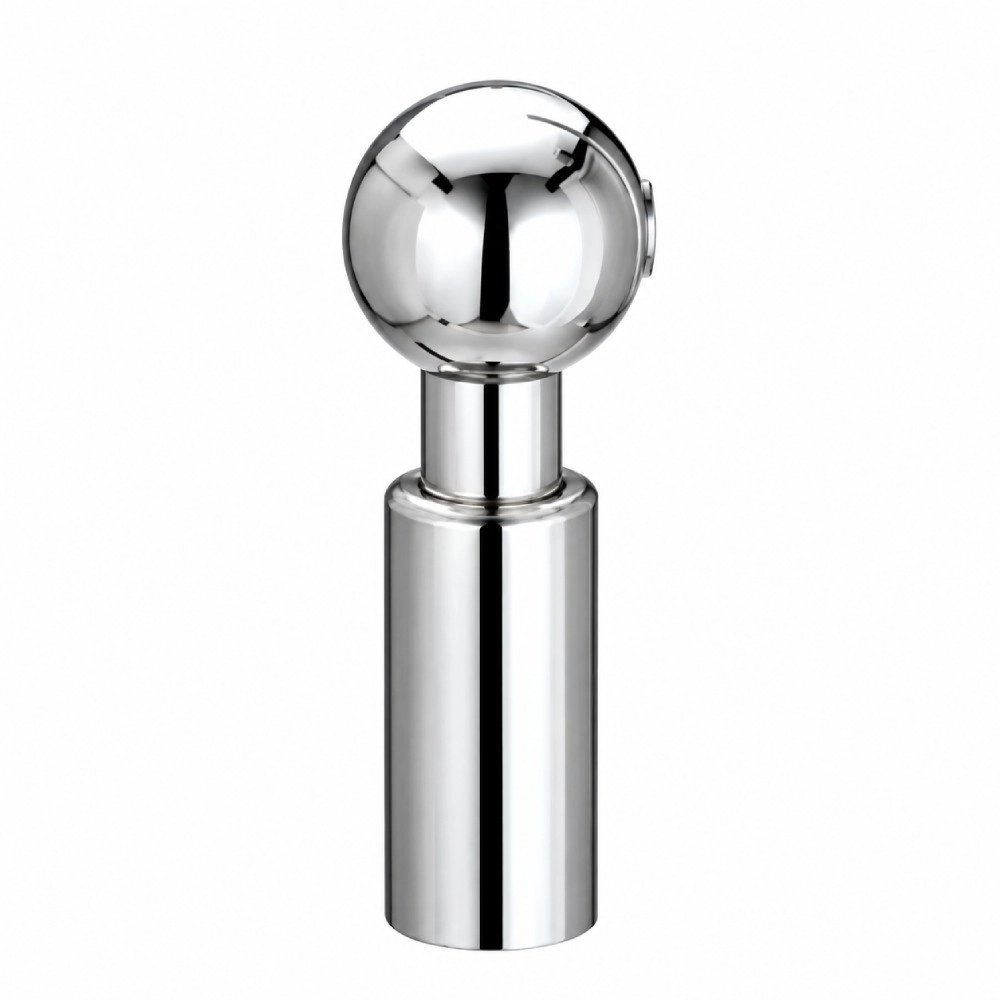
Sanitary Welding Rotary Cleaning Ball
Oystar Sanitary Welding Rotary Cleaning Ball supports cleaning-liquid distribution in compatible hygienic tanks and process vessels. Suitable for selected CIP applications, with material, connection, and operating specifications confirmed according to the required model.
Material Compliance & Dimensional Specifications
Standard dimensions and manufacturing tolerances adhering strictly to ASTM and sanitary standards:
The Sanitary Welding Rotary Cleaning Ball by Oystar Dairy Fittings is a hygienic cleaning component designed for use in suitable industrial tanks, vessels, and process equipment. It supports internal cleaning by distributing cleaning liquid through rotating spray action, helping remove product residues and deposits from internal surfaces.
Designed for compatible Clean-in-Place (CIP) applications, a rotary cleaning ball can help reduce manual cleaning requirements and improve the consistency of routine equipment cleaning. The welding connection allows the cleaning device to be integrated into compatible pipelines, tanks, or process systems where a permanent hygienic connection is required.
Oystar offers sanitary process equipment solutions for applications where cleanliness, reliable operation, and hygienic design are important. Buyers should confirm the required spray pattern, connection dimensions, material grade, operating pressure, temperature range, and cleaning-fluid compatibility before ordering.
The Sanitary Welding Rotary Cleaning Ball is intended for suitable hygienic processing environments where effective cleaning of internal equipment surfaces is part of the production and sanitation process.
3. Applications of Sanitary Welding Rotary Cleaning Ball
The Oystar Sanitary Welding Rotary Cleaning Ball can be considered for the following applications, subject to equipment compatibility:
- Internal cleaning of process tanks and storage vessels.
- Cleaning of suitable dairy processing tanks.
- Cleaning of compatible mixing and blending vessels.
- CIP systems used in hygienic manufacturing environments.
- Cleaning of food and beverage processing equipment.
- Removal of suitable product residues from internal vessel surfaces.
- Cleaning support for hygienic process equipment.
- Integration into systems requiring a welded sanitary connection.
The appropriate cleaning device depends on tank geometry, internal obstructions, residue characteristics, cleaning-fluid properties, and the required level of surface coverage.
4. Industries Where the Product Is Used
Dairy Processing Industry
Suitable rotary cleaning equipment can support cleaning procedures for compatible milk storage tanks, processing vessels, and dairy production equipment.
Food Processing Industry
Food manufacturers may use suitable rotary cleaning devices to support cleaning of mixing tanks, storage vessels, and other compatible process equipment.
Beverage Industry
Breweries, beverage manufacturers, and liquid processing facilities may require tank-cleaning components compatible with their cleaning procedures and process conditions.
Pharmaceutical Industry
Certain pharmaceutical manufacturing applications require hygienic equipment cleaning. Selection must comply with the facility\\\\\\\'s validated cleaning process and applicable material and design requirements.
Biotechnology Industry
Compatible process vessels and production equipment may use rotary cleaning devices as part of an established cleaning system.
Cosmetics and Personal Care Industry
Manufacturers of lotions, creams, shampoos, and liquid personal-care products may require suitable equipment for cleaning process vessels and mixing tanks.
Chemical and Specialty Liquid Processing
Selected non-hazardous or compatible liquid-processing applications may use rotary cleaning equipment, provided all wetted materials are suitable for the chemicals and operating conditions.
5. Benefits of Sanitary Welding Rotary Cleaning Ball
Rotary cleaning action: Supports the distribution of cleaning liquid inside compatible vessels.
CIP integration: Can be incorporated into suitable Clean-in-Place systems.
Welded installation: Provides a permanent connection where the equipment design requires one.
Cleaning consistency: Can help make repeatable cleaning procedures easier to implement.
Reduced manual intervention: May reduce the need for manual internal cleaning, depending on system design.
Hygienic processing support: Suitable for applications where sanitary equipment design is important.
Application flexibility: Can be evaluated for different tanks and process vessels.
Process efficiency: Appropriate selection and installation may help improve cleaning workflow.
Equipment integration: Can be specified as part of a broader hygienic process system.